
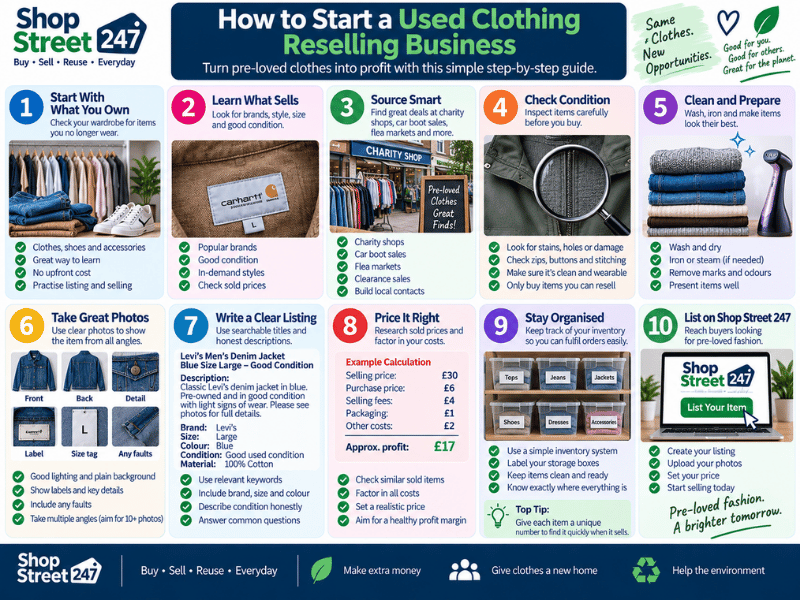
How to Start a Used Clothing Reselling Business
From Your Wardrobe to a Growing Resale Business
What if the clothes sitting unworn in your wardrobe could be the beginning of your own reselling business?
You don’t necessarily need a warehouse, expensive photography equipment or hundreds of items to get started.
You can begin with a handful of clothes you already own, learn how selling works and gradually reinvest some of what you make.
Used clothing can be particularly attractive for resellers because it’s relatively easy to photograph, store, pack and post compared with many bulky or fragile products.
Whether you simply want to make some extra money or eventually build a larger resale operation, here’s how to get started.
1. Start With What You Already Own
Before spending money on stock, open your wardrobe.
Look for good-quality items you no longer wear, such as:
👕 T-shirts
👖 Jeans
🧥 Jackets
👗 Dresses
👟 Sneakers
👜 Bags
🧢 Accessories
👔 Shirts
This is one of the lowest-risk ways to learn reselling.
You can practise:
- Taking product photographs
- Writing listing titles
- Describing condition
- Setting prices
- Communicating with buyers
- Packing orders
- Dispatching products
And because you already own the items, you don’t need to immediately invest money in inventory.
Don’t Have Enough to Sell?
Consider asking friends or relatives whether they have unwanted clothes they’re happy to give you.
You may be surprised by how many perfectly usable items are sitting in wardrobes waiting to be cleared out.
2. Learn What Makes Used Clothing Sell
Not every second-hand item has the same resale potential.
When examining an item, consider:
Brand
Is it a brand people actively search for?
Condition
Check for stains, holes, fading, missing buttons, damaged zips and excessive wear.
Size
Some sizes may attract more potential buyers than others, depending on the product and market.
Style
Is it a style people are currently interested in?
Material
Fabric and construction can sometimes affect desirability and value.
Potential Selling Price
What are comparable used items actually selling for?
One of the best ways to build knowledge is through experience.
Research products as you encounter them and gradually learn which brands, styles, materials and product types are worth your time.
The reseller featured in the source describes starting by looking up products individually while sourcing and gradually learning brands, materials, styles and values through research and trial and error.
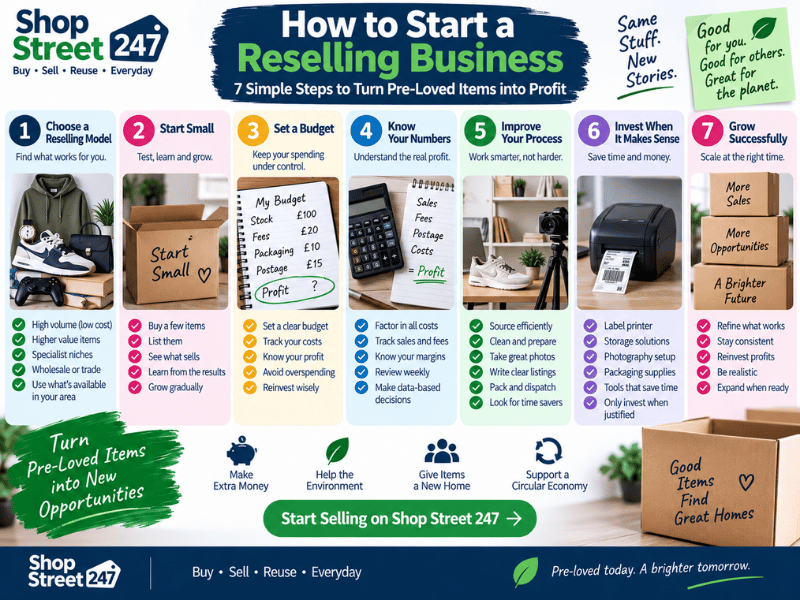
3. Start Sourcing Small
Once you’ve sold some of your own belongings and understand the basic process, you might decide to buy products specifically to resell.
Potential sources can include:
Charity shops
Car boot sales
Flea markets
Clearance sales
Friends and family
Local second-hand sellers
House clearances
Bulk clothing suppliers
Start small.
You don’t need hundreds of items.
Try buying a few pieces, listing them and watching what happens.
The Basic Reselling Model
BUY LOW
↓
CLEAN & PREPARE
↓
CREATE A GREAT LISTING
↓
SELL
↓
CALCULATE YOUR ACTUAL PROFIT
↓
REINVEST CAREFULLY
A bargain is only a bargain if somebody eventually wants to buy it.
4. Check Brand AND Condition Before Buying
Finding a recognised brand doesn’t automatically mean you’ve found a profitable item.
Always inspect the condition too.
Imagine finding a desirable jacket for £5.
Sounds great.
But then you discover:
❌ Broken zip
❌ Large stain
❌ Hole in the sleeve
❌ Missing button
❌ Significant fabric damage
Suddenly that £5 bargain might not look so attractive.
Before purchasing inventory, ask:
What could this realistically sell for in its current condition?
Not:
What did this cost when it was brand new?
The source’s sourcing example similarly focuses on both brand and condition when assessing clothing.
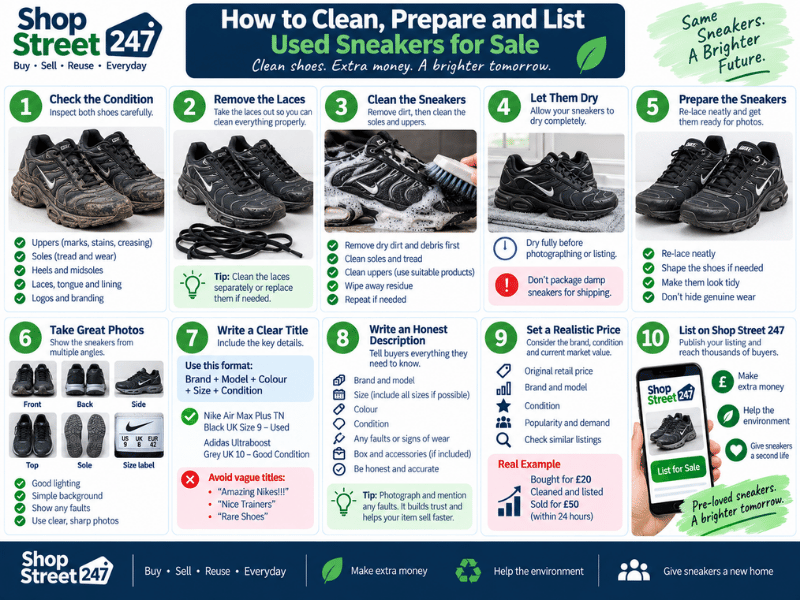
5. Clean and Prepare Clothing Before Listing
Presentation matters.
Where appropriate, clean clothing according to its care instructions before photographing it.
Check that the item is:
✓ Clean
✓ Dry
✓ Presentable
✓ Free from strong odours
✓ Ready to photograph
Ironing or steaming suitable garments can also improve presentation.
But don’t try to disguise permanent damage.
If an item has a mark, repair, faded area or other fault that remains after cleaning, photograph it and disclose it in the description.
Good presentation attracts buyers. Honest presentation builds trust.
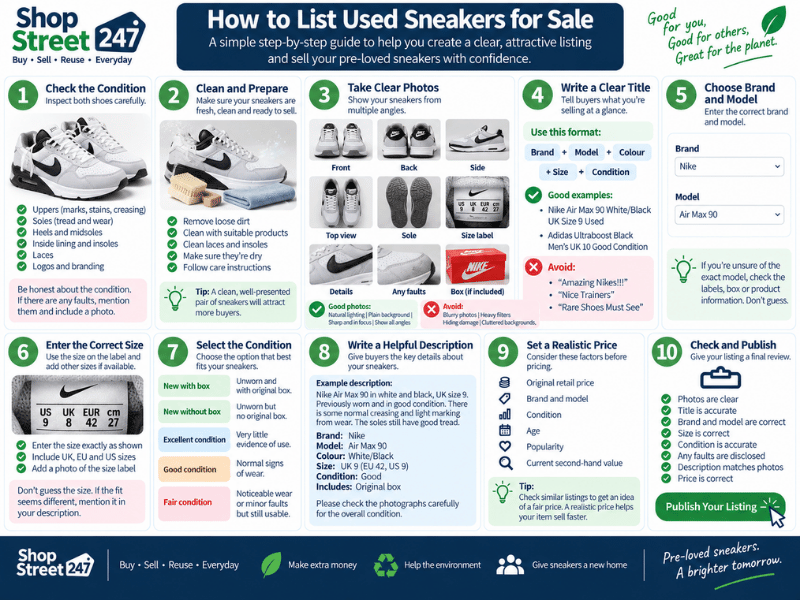
6. Take Clear, Detailed Photos
You don’t need a professional photography studio to begin.
A clean background and good lighting can be enough.
For a typical clothing listing, photograph:
📸 Front
📸 Back
📸 Brand label
📸 Size label
📸 Material/care label
📸 Important details
📸 Patterns or logos
📸 Any faults
The source’s reseller says he aims for around 12 photographs per item, covering areas such as the front, sides, arms and size tag, while emphasising clear pictures of flaws.
Photo Tip
Think about the questions a buyer might ask.
“What’s the label like?”
Photograph it.
“Is there wear on the sleeve?”
Photograph it.
“What does the back look like?”
Photograph it.
Your pictures should help buyers understand exactly what they’re purchasing.
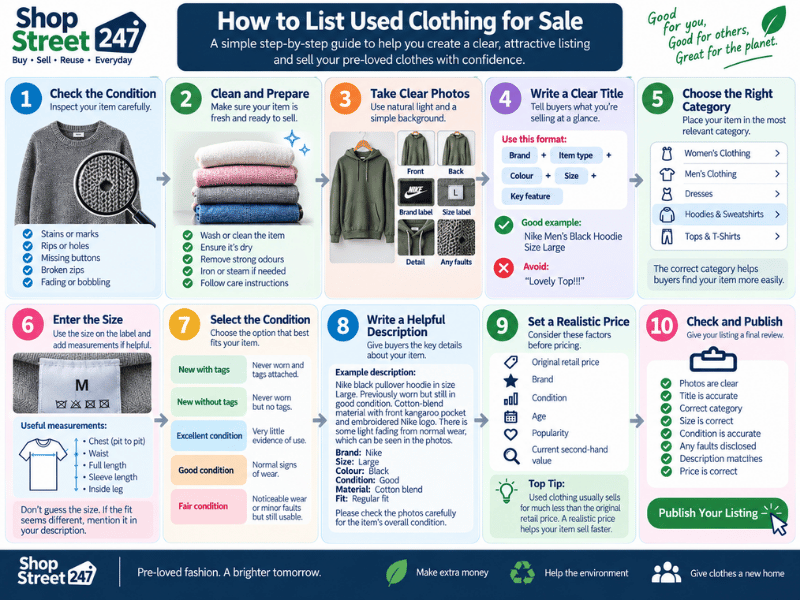
7. Write Search-Friendly Titles
Your title matters.
Don’t write:
❌ “Lovely Jacket”
Instead, include useful identifying information.
Try:
Brand + Item + Style + Colour + Size + Key Feature
For example:
Columbia Men’s Vintage Green Parka Jacket Size Large
or:
Levi’s Women’s Blue Straight Leg Jeans W30
Think about what someone looking for that exact product might type into search.
The transcript specifically highlights relevant keywords in clothing titles to help buyers discover listings.
8. Write Descriptions That Answer Questions
A good description can reduce uncertainty for buyers.
Include:
Brand: Levi’s
Item: Men’s Jeans
Colour: Blue
Size: W34 L32
Fit: Straight Leg
Condition: Good used condition
Material: See photographed label
Then describe any important signs of wear.
For example:
“Previously worn Levi’s jeans in good used condition. There is some light fading around the knees from normal wear. Please see the photographs for the overall condition and measurements.”
Don’t exaggerate.
The goal is to help the buyer understand what they’re getting.
The source argues that strong photographs, descriptions and titles can also reduce repetitive buyer questions because much of the information is already available in the listing.
9. Price for the Second-Hand Market
Don’t choose your price based purely on the item’s original retail price.
Research similar second-hand products.
Compare:
🏷️ Brand
👕 Style
⭐ Condition
📏 Size
📅 Age
🔥 Demand
💷 Comparable selling prices
And don’t forget your costs.
Example
Selling price: £30
Purchase price: £6
Selling/payment costs: £4
Packaging: £1
Other applicable costs: £2
Approximate Profit: £17
Your actual figures will depend on where and how you sell.
Always calculate your own costs rather than assuming that the difference between the buying and selling prices is pure profit.
10. Make Organisation a Priority
Selling ten items from your bedroom is relatively straightforward.
Selling hundreds is different.
Imagine receiving an order for:
“Nike Men’s Grey Hoodie – Large”
You know you own it.
But where is it?
Under the bed?
In a box?
On a rail?
In the loft?
Good inventory organisation becomes increasingly important as your business grows.
The source stresses organisation as a critical reselling skill because poor systems can lead to lost products, delayed orders and difficulty locating inventory.
Simple Inventory System
Give every listed product a unique inventory number.
For example:
SS247-0001
Store it in:
Box A
Your records could show:
SS247-0001 → Box A
When it sells, you know exactly where to find it.
11. Build Multiple Ways to Find Stock
Don’t become completely dependent on one source of inventory.
Imagine your entire business depends on one local supplier.
Then they stop selling to you.
What happens?
A more resilient sourcing strategy might include:
Source A: Charity shops
Source B: Car boot sales
Source C: Local contacts
Source D: Clearance stock
Source E: Clothing wholesalers
Source F: Private collections
You don’t need all of these when you’re starting.
But as you grow, having several potential sources can reduce your dependence on any single one.
This was one of the source seller’s major lessons after losing a previous supplier: he recommends developing multiple avenues for sourcing rather than relying entirely on one supplier or location.
12. Build Relationships With Suppliers
Reselling isn’t only about finding products.
Relationships can become extremely valuable.
If you regularly buy from a charity shop, car-boot seller, wholesaler or other supplier, they may begin to understand what you’re looking for.
Over time, opportunities may come to you.
A supplier might say:
“I’ve got another five bags of jeans coming next week. Are you interested?”
That’s very different from having to find every individual item yourself.
The source specifically identifies cultivating relationships as something the reseller wishes he’d understood earlier, noting that established sourcing relationships can lead directly to additional stock opportunities.
13. Don’t Rush Into Buying Huge Quantities
Buying in bulk can reduce your average purchase price.
But there’s another side to it.
You need to:
Sort it.
Inspect it.
Clean it.
Photograph it.
List it.
Store it.
Sell it.
Pack it.
Dispatch it.
Cheap stock isn’t automatically profitable stock.
The source describes bulk clothing as potentially extremely inexpensive, but also acknowledges that not everything in a bulk load is good and that considerable sorting, washing, cleaning and preparation is required.
Start with quantities you can realistically process.
14. Create a Repeatable Reselling System
As your inventory increases, create a process.
SOURCE
Find potentially profitable items.
↓
SORT
Separate products into categories.
↓
INSPECT
Check condition and identify faults.
↓
CLEAN
Prepare items appropriately.
↓
PHOTOGRAPH
Take clear, consistent pictures.
↓
LIST
Create accurate titles and descriptions.
↓
STORE
Assign an inventory location.
↓
SELL
Process the order.
↓
PACK
Protect the product appropriately.
↓
DISPATCH
Send it within your stated timeframe.
A repeatable workflow makes larger quantities of inventory less overwhelming.
15. Scale Only When the Numbers Make Sense
You don’t need employees when you’re selling a few items each week.
You don’t need a warehouse when your inventory comfortably fits at home.
You don’t need expensive equipment when a simple setup works.
Grow when there’s a genuine business reason to grow.
You Might Eventually Invest In:
📦 Storage systems
🖨️ Label printer
📸 Photography setup
⚖️ Shipping scales
🧺 Cleaning equipment
💻 Inventory software
👥 Additional help
🏢 Dedicated workspace
The business profiled in the source eventually grew to a team handling sorting, photography and other tasks, but the seller describes initially doing sourcing, preparation, listing and shipping himself before adding help.
The Shop Street 247 Used Clothing Reselling Blueprint
ðŸ START AT HOME
Sell clothing you already own.
↓
📚 LEARN
Research brands, styles, condition and second-hand values.
↓
ðŸ›ï¸ SOURCE
Buy small quantities of promising stock.
↓
🧼 PREPARE
Clean and inspect everything.
↓
📸 PHOTOGRAPH
Show the item clearly and honestly.
↓
📠LIST
Create searchable titles and useful descriptions.
↓
📦 ORGANISE
Give every product a storage location.
↓
💷 SELL
Price realistically and provide a good buyer experience.
↓
🔄 REINVEST
Use some of your profits to source additional inventory.
↓
📈 GROW
Expand your inventory, sourcing and systems when the results justify it.
Start Small. Learn. Then Grow.
You don’t have to start your reselling journey with thousands of pounds.
You don’t need hundreds of products.
And you certainly don’t need a warehouse.
Start with one item.
Take some good photographs.
Create an honest description.
Set a realistic price.
Make your first sale.
Then do it again.
As you gain experience, you’ll learn which products sell, where to find them, how much you’re prepared to pay and how to process them efficiently.
Eventually, what started as clearing out your wardrobe could become something much bigger.
Ready to Start Your Reselling Journey?
Open your wardrobe.
Find something you no longer need.
Prepare it for its next owner.
And list it for sale on Shop Street 247.
Shop Street 247
Buy • Sell • Reuse • Everyday
Pre-loved today. A brighter tomorrow.