
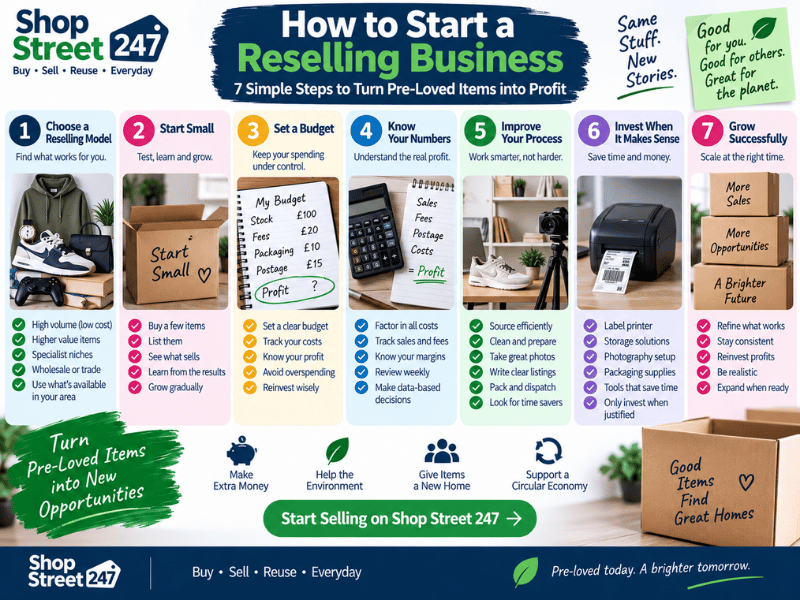
How to Start a Reselling Business: 7 Steps for Beginners
Want to Make Money Selling Second-Hand Items? Start Here.
Reselling can begin with something as simple as clearing out your wardrobe and selling things you no longer use.
But what if you want to take it further?
Perhaps you’d like to regularly buy second-hand products and resell them for a profit. Maybe you’re looking for a side hustle, or perhaps your long-term ambition is to build a much larger resale business.
Whatever your goal, one of the biggest mistakes you can make is buying up piles of stock before you understand what you’re doing.
A better approach is to start small, understand your numbers, develop a repeatable system and grow gradually.
Here are seven steps to help you get started.
1. Choose a Reselling Model That Works for You
There’s no single “correct” way to become a reseller.
Different sellers can use completely different strategies and still build successful businesses.
The right approach depends on things such as:
- How much time you have
- How much money you’re prepared to invest
- What products you understand
- What second-hand stock you can find
- How much storage space you have
- Whether you enjoy sourcing or listing
- How quickly you want products to sell
- Your overall goals
For Example: The Volume Model
Some resellers focus on buying inexpensive products and listing a large number of them.
The profit on an individual item might not be huge, but the seller aims to generate profit across many sales.
The challenge?
You need enough low-cost stock, storage space and time to process and list everything.
Another Approach: Higher-Value Products
Instead of listing hundreds of inexpensive products, another seller might focus on fewer products with higher selling potential or margins.
This may require more product knowledge and potentially more money per item.
Ask Yourself:
What do I enjoy selling?
What products can I realistically source?
How much time can I dedicate to this?
How much money can I afford to invest?
How much storage space do I have?
Don’t simply copy another reseller’s business model.
Build one that fits your circumstances.
2. Start Small
You’ve bought your first item.
You list it.
It sells.
Suddenly you think:
“This is easy! I need to buy 100 more!”
Slow down.
One successful sale doesn’t necessarily mean you’ve found a scalable business model.
A common beginner mistake is buying too much inventory too quickly.
Instead, start with a small amount of stock and test your ideas.
A Better Approach
Buy a few items
↓
List them
↓
See what sells
↓
Review the results
↓
Buy more of what works
Starting slowly gives you time to learn without putting too much money at risk.
The source behind this guide strongly recommends a slow build, spending as little as is practical initially and ensuring purchases fit your chosen model before expanding.
3. Set a Buying Budget
Reselling can become surprisingly addictive.
You find something for £5 that you think could sell for £20.
Then another.
Then another.
Before you know it, you’ve spent £500 on products that haven’t sold yet.
Set yourself a sourcing budget.
For example:
Weekly Reselling Budget
Stock budget: £100
Maximum individual purchase: £20
Target selling price: £25+
Target profit: Set according to your own costs and goals
Your actual figures will depend on your business model.
The important thing is having boundaries.
Don’t treat every pound of sales revenue as money you can immediately spend on more stock either.
You need to understand what’s actually profit after your expenses.
4. Know Your Numbers
This is one of the most important parts of reselling.
Selling something for more than you paid for it doesn’t automatically mean you’ve made as much profit as you think.
Imagine:
You buy an Item for £10
You sell it for:
£30
It might initially look like you’ve made:
£20 profit
But what about:
- Marketplace/payment costs
- Packaging
- Delivery costs you’re responsible for
- Cleaning supplies
- Travel
- Other business expenses
Your real profit could be lower.
Numbers Worth Tracking
Cost of Goods
How much are you paying for your inventory?
Average Selling Price
What’s the average price your products actually sell for?
Sell-Through Rate
How much of the inventory you’re listing is actually selling?
Expenses
How much are you spending on everything needed to operate?
Profit
What’s left after relevant costs?
Time
How many hours are you spending sourcing, cleaning, photographing, listing, packing and managing orders?
The transcript specifically recommends beginners review their numbers every week, including money coming in and going out, fees, shipping and other expenses.
5. Remember: Your Time Has Value
Imagine two products.
Product A
Profit: £15
Time required:
10 minutes
Product B
Profit: £20
Time required:
90 minutes
Product B makes more profit per sale.
But is it actually the better product for your business?
Not necessarily.
This is why you should look beyond the headline profit figure.
Think about how long it takes to:
🔎 Find products
🧼 Clean or prepare them
📸 Photograph them
📝 Create listings
📦 Pack orders
🚚 Arrange dispatch
💬 Deal with enquiries
As you gain experience, you’ll start identifying products that aren’t worth the amount of work they require.
6. Improve Your Reselling Process
Once you’ve worked out what’s selling, don’t immediately try to build a massive operation.
First, improve what you’re already doing.
Think about your complete workflow.
Your Reselling System
SOURCE
↓
INSPECT
↓
CLEAN
↓
PHOTOGRAPH
↓
LIST
↓
STORE
↓
SELL
↓
PACK
↓
DISPATCH
Look for unnecessary steps.
Could you photograph several products at once?
Could you prepare packaging in advance?
Could you create a standard checklist for inspecting used clothing?
Could you keep a dedicated photography area ready?
Could you organise inventory so sold products are easier to find?
Small improvements can add up when you’re processing dozens or hundreds of products.
The original source describes this as continually refining processes and trying to make incremental improvements once you understand what works.
7. Invest When It Actually Saves You Time or Money
Starting a reselling business doesn’t mean you immediately need expensive equipment.
Use simple solutions while you’re learning.
As your sales increase, however, some investments may become worthwhile.
For example, a seller processing lots of orders might eventually find that a dedicated label printer saves considerable time compared with printing labels on normal paper, cutting them out and attaching them manually.
The question shouldn’t simply be:
“Would this be nice to have?”
Ask:
“Will this save enough time or money to justify the cost?”
Potential investments might include:
- Label printer
- Storage shelving
- Photography equipment
- Packaging supplies
- Inventory-management tools
- Cleaning equipment
Research each investment before spending money.
The transcript gives the example of a label printer that initially seemed expensive but ultimately saved both processing time and consumable costs.
BONUS: Don’t Rush Into Hiring or Expensive Premises
Your resale business is growing.
Orders are coming in.
You’re busy.
You might start thinking:
“I need employees.”
Or:
“I need a warehouse.”
Those can be major financial commitments.
Before expanding, make sure your existing operation is efficient and your numbers support the decision.
Ask Yourself:
Is the business consistently profitable?
Do I understand my costs?
Is there enough demand?
Have I made my current process as efficient as possible?
Can the business comfortably afford the additional expense?
Will the investment genuinely help me grow?
The source recommends repeatedly returning to your numbers, processes and investment decisions before moving to major commitments such as employees or warehouse space.
The Reseller Growth Cycle
Building a resale business isn’t a straight line.
Think of it as a continuous cycle:
📊 1. Review Your Numbers
What sold?
What didn’t?
What made money?
What cost too much?
↓
âš™ï¸ 2. Improve Your Process
What could you do faster?
What could you do better?
What unnecessary work could you eliminate?
↓
💷 3. Make Smart Investments
Is there something that could genuinely save time or reduce costs?
↓
🔄 4. Repeat
Review the numbers again.
Why?
Because things change.
Buyer demand changes.
Trends change.
Product availability changes.
Your own goals can change.
A reselling strategy that works today isn’t guaranteed to work forever.
What Can You Resell?
One of the great things about second-hand selling is the enormous range of products available.
Depending on your interests, knowledge and what you can source, this might include:
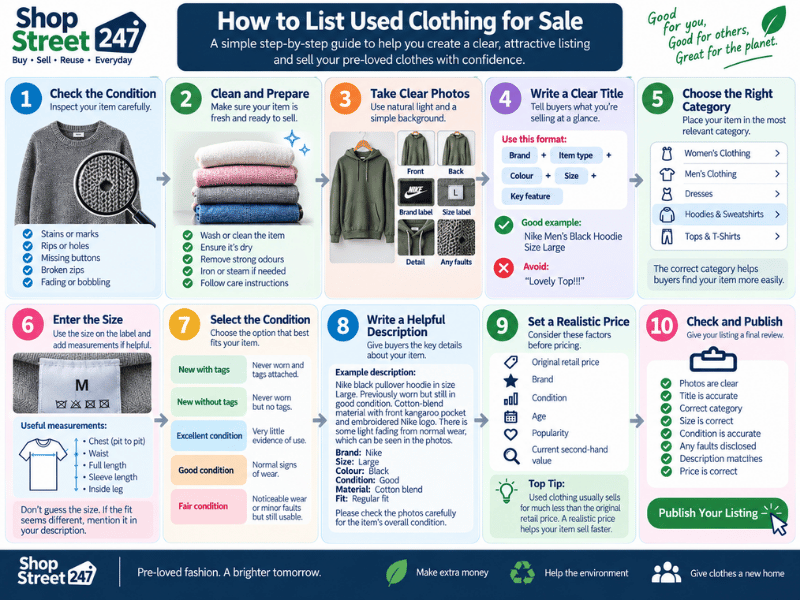
👕 Pre-loved clothing
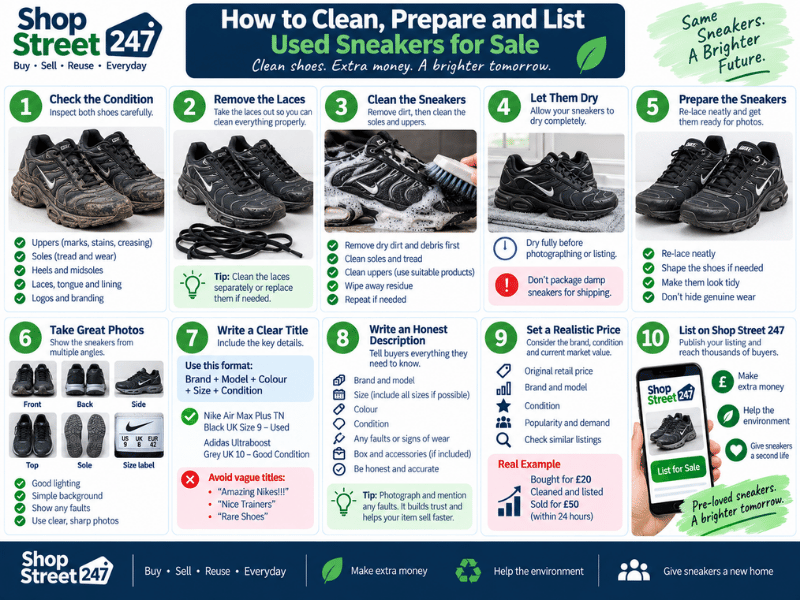
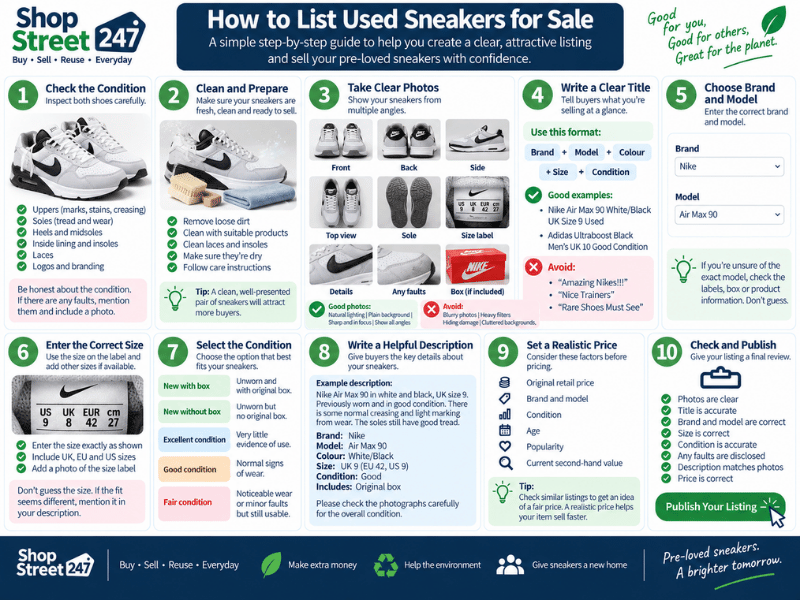
👟 Used sneakers and footwear
👜 Bags and accessories
🎮 Games and consoles
📱 Electronics
🏠 Homeware
🧸 Toys and collectables
📚 Books
⚽ Sports equipment
⌚ Watches and accessories
You don’t have to sell everything.
In fact, specialising in categories you understand can make it easier to recognise good products and assess their condition and potential value.
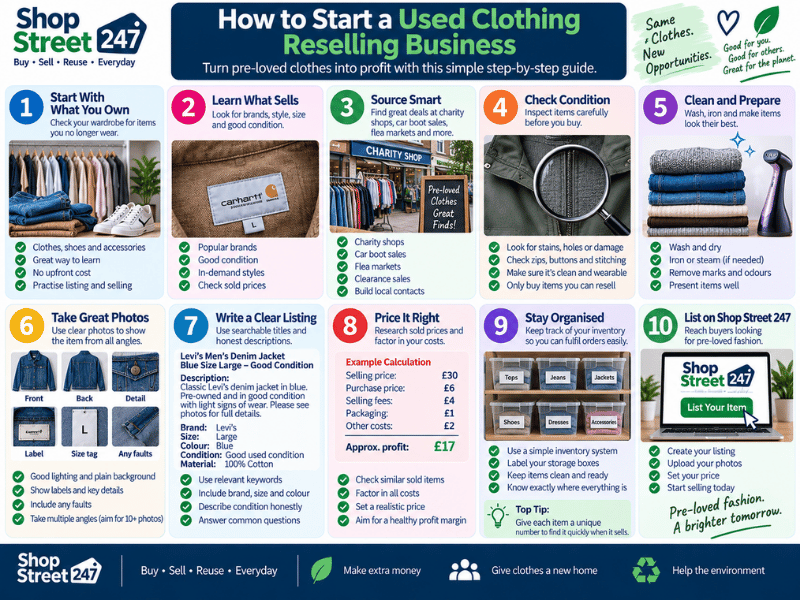
Start With What You Already Own
You don’t necessarily need to go out and spend hundreds of pounds on stock.
Look around your own home first.
You may already have:
- Clothes you don’t wear
- Sneakers sitting in boxes
- Old games
- Unwanted electronics
- Books you’ve finished
- Collectables you no longer want
- Household items you don’t use
Selling your own unwanted belongings can give you experience with:
Taking photographs
Writing descriptions
Pricing
Communicating with buyers
Packing
Dispatching
Understanding what sells
And you can learn these skills before investing heavily in inventory.
Your Beginner Reselling Plan
STEP 1 — RESEARCH
Choose the type of reseller you want to become.
↓
STEP 2 — START SMALL
Test your idea without buying huge amounts of stock.
↓
STEP 3 — SET A BUDGET
Control how much you’re spending.
↓
STEP 4 — TRACK
Know your sales, costs, profit and time.
↓
STEP 5 — LEARN
Identify what’s actually working.
↓
STEP 6 — REFINE
Make your sourcing, listing and fulfilment processes more efficient.
↓
STEP 7 — GROW
Invest and expand only when your results justify it.
Build Your Reselling Journey With Shop Street 247
You don’t need hundreds of products, a warehouse or a complicated operation to start selling second-hand goods.
Start with one item.
Learn how to photograph it properly.
Write an accurate description.
Set a sensible price.
Make your first sale.
Then learn from it.
Start small → Track → Learn → Improve → Repeat → Grow
Whether you’re clearing out your wardrobe, building a side hustle or developing a larger resale business, Shop Street 247 can be a place to turn unwanted products into new opportunities.
Ready to Start Selling?
Find something you no longer need, get it ready for its next owner and list it on Shop Street 247.
Shop Street 247
Buy • Sell • Reuse • Everyday